A job offer can look straightforward until the contract arrives. In Romania, the employee versus contractor Romania question affects far more than the title on a document. It can shape who controls your schedule, what protections apply, how your residence status is handled, and whether the day-to-day reality of the role matches its legal form.
For foreign professionals and companies hiring internationally, the safest choice is rarely the one with the shortest paperwork. It is the arrangement that accurately reflects how the work will actually be done.
Employee versus contractor in Romania: the core distinction
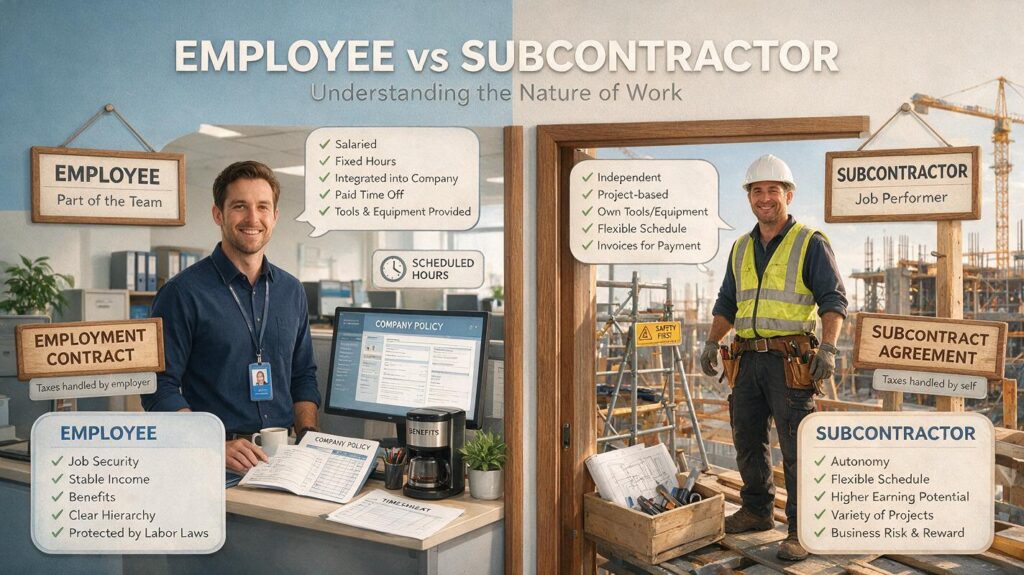
An employee works under an individual employment agreement, usually called a CIM, from the Romanian Contract Individual de Munca. The relationship is governed primarily by the Romanian Labor Code. The employer directs the work, sets or approves the working arrangement, provides an organizational structure, and carries responsibilities toward the employee.
A contractor, by contrast, provides services independently. They may operate through a registered sole-proprietor form, such as a PFA, or through a company. The client purchases an agreed service or result rather than managing the person as part of its workforce.
That distinction sounds simple, but the written agreement is only one part of the picture. If a person is called a contractor but works fixed hours, reports to a manager, uses the client’s systems exclusively, follows internal leave approval rules, and has little control over how work is delivered, the relationship may look much more like employment in practice.
What an employment relationship usually provides
For someone relocating to Romania for a stable role, employment is often the clearer and more protective route. A Romanian employment agreement generally establishes the job function, workplace or remote-work terms, working time, compensation, notice arrangements, and other core conditions in writing.
Employees benefit from protections set by labor law. These include paid annual leave, limits on normal working time, rules on rest periods and overtime, workplace health and safety obligations, and formal procedures around disciplinary action and termination. The statutory minimum annual leave is 20 working days, although many employers offer more.
The employer also carries the administrative burden connected with the employment relationship. Before work begins, the agreement must be registered through the appropriate employee-record system. For an expat, this can make the arrangement easier to understand because there is one organization responsible for onboarding, documentation, and workplace compliance.
Employment is not automatically the best answer, however. It comes with less independence. You are normally part of the company’s hierarchy, subject to its policies, and expected to perform the role personally under its direction. That is ideal for a long-term position on a local team, but less suitable for an independent consultant serving several clients.
Remote work needs to be stated clearly
Romania recognizes remote work, but it should not be treated as an informal side arrangement. If an employee will work from home in Bucharest, from another Romanian city, or on a hybrid basis, the contract should clearly reflect the working model and relevant practical expectations.
For a foreign hire, this matters because “remote” does not erase the need for a proper legal relationship. A company based abroad may still need a locally compliant setup if it is directing an employee who is habitually working from Romania.
How contracting works in practice
A genuine contractor usually has more control over their professional activity. They negotiate the scope of work, choose the methods used to deliver it, organize their own schedule, and can often take on other clients. The client may set deadlines and quality standards, but should not manage the contractor in the same way it manages an employee.
A contractor agreement should focus on the service: deliverables, timeline, fees, confidentiality, intellectual-property ownership, liability, and how either party can end the engagement. It should not simply copy an employment contract while replacing the word “employee” with “consultant.”
For many digital nomads and specialists, contracting is attractive because it can support a more flexible working life. A designer with clients in several countries, an independent software consultant, or a project-based adviser may value the freedom to set their own terms and workload.
That freedom also means taking responsibility for the business side of the arrangement. Contractors need an appropriate legal basis to provide services in Romania, organized records, and a clear understanding of their contractual commitments. They do not automatically receive the leave, notice protections, or workplace benefits that employees may receive.
The risk of misclassification
Misclassification happens when a relationship is presented as independent contracting even though it functions as employment. It is a concern for both parties, especially when the contractor relies on one client and operates as if they are a member of that client’s staff.
No single fact decides the issue. The overall working reality matters. A contractor who uses their own tools, determines how the work is performed, has multiple clients, and bears meaningful business risk is easier to distinguish from an employee. A person required to be online from 9 to 5, attend mandatory internal meetings, seek approval for time off, and follow a manager’s daily instructions may not be.
The goal should not be to design a contract that merely appears independent. It should be to select a model that fits the relationship honestly. Companies should resist using contractor arrangements solely to avoid the duties attached to employment. Contractors should also be cautious when a proposed “freelance” role offers no real freedom beyond the label.
Immigration status can change the answer
For non-EU nationals, the choice between employee and contractor can have immigration consequences. A Romanian employer hiring a non-EU citizen for local employment will generally need to follow the work authorization process before the individual can obtain or maintain the relevant right of stay for employment.
Independent activity follows a different path. Having a client agreement does not, by itself, give a foreign national the right to live in Romania or carry out self-employed work here. The person’s residence basis, business registration, and authorized activity need to align.
EU, EEA, and Swiss citizens generally have broader access to work in Romania, though registration and residence formalities may still apply for longer stays. The practical lesson is the same: decide first how the work will be performed, then make sure the immigration route supports that model. Do not assume a contractor invoice solves a residence issue.
Which arrangement fits your situation?
The right answer depends on the substance of the role. Before signing, ask four practical questions:
- Who decides the work hours, methods, and priorities?
- Will the person work mainly for one organization or build a portfolio of clients?
- Is the role ongoing and integrated into a Romanian team, or limited to a defined project?
- Does the person have the immigration and business status needed for the proposed arrangement?
A full-time marketing manager joining a company in Cluj-Napoca, reporting to a department head, and using company systems will usually fit an employment agreement. An architect advising several clients on separate projects may be better placed as an independent provider. A foreign software developer working remotely for one overseas company falls into a more nuanced category and deserves careful review of both the work reality and their right to stay in Romania.
What to check before you sign
Whether you are hiring or relocating, read beyond the headline rate. Employees should understand the probation period, notice provisions, work location, remote-work terms, leave entitlement, confidentiality clauses, and any restrictive covenants. Contractors should focus on scope creep, payment timing, ownership of work product, liability limits, termination rights, and whether the agreement preserves genuine independence.
If the arrangement crosses borders, clarity becomes even more valuable. Ask who is the legal contracting party, where the work is expected to be performed, and what documentation is needed before the first day of work. A short conversation with a qualified Romanian employment and immigration professional can prevent a costly mismatch later.
Romania offers room for both stable employment and independent professional work. The useful starting point is not which label seems easier, but which one lets you work, live, and plan with confidence.