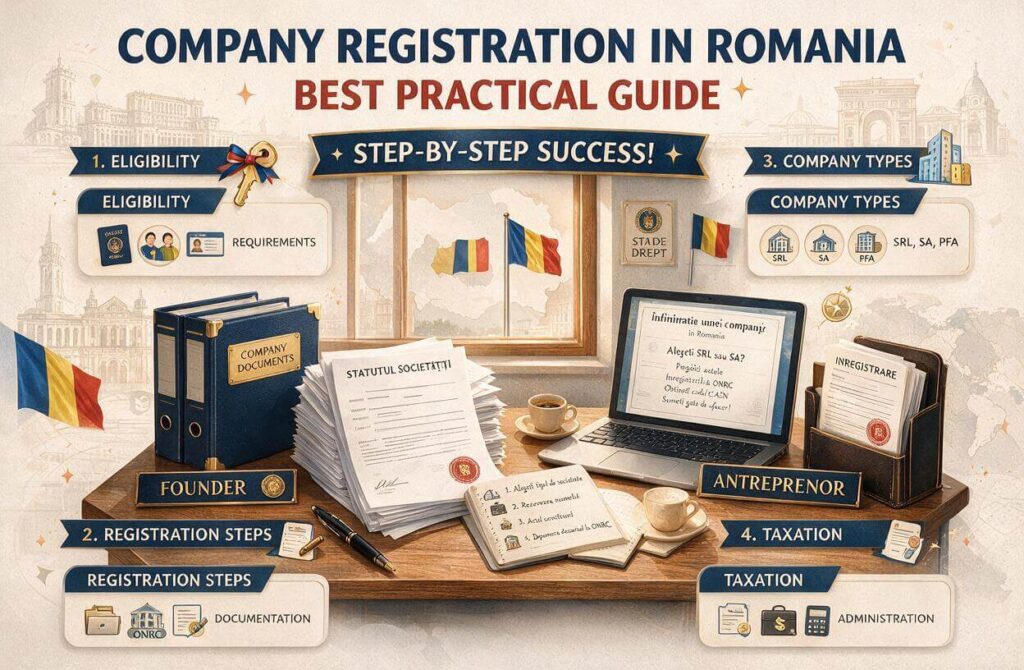
Romania can be a very workable place to build a business, but the first surprise for many foreign founders is that the setup process is formal, document-based, and less forgiving than it looks from a distance. If you want to register a company in Romania, the real challenge is usually not the business idea. It is getting the legal form, paperwork, timing, and local administrative details right from the start.
For expats, digital entrepreneurs, and international founders, that matters because company formation often connects to bigger life decisions. You may be planning a local client contract, relocating your family, applying for residency on a business basis, or simply creating a Romanian presence for a new venture. The registration itself is only one step, but it is the step that everything else tends to lean on.
Before you register a company in Romania
The first decision is not the company name. It is the legal structure.
Most small and medium-sized foreign-owned businesses choose an SRL, which is the Romanian limited liability company. It is popular because it is familiar, flexible, and generally suitable for consulting, services, trading, small agencies, tech startups, and many owner-managed businesses. Larger operations or businesses planning more complex governance may look at other forms, but for most expats entering the Romanian market, the SRL is the practical default.
That said, default does not always mean best. If you are testing the market alone, an SRL may still be right, but you should think ahead about how many shareholders you expect, who will manage the company, and whether your Romanian entity will be an active operating business or a local arm of a foreign business. Those choices affect the documents you prepare and how cleanly the registration moves.
You will also need a registered office in Romania. This is not a minor detail. The company must have a legal address, and the right to use that address has to be documented. Some founders use leased office space, some use virtual office arrangements, and some rely on a host address where legally permitted. What matters is not what sounds easiest, but what can be documented properly.
Choosing the company name and business activity
Romania requires a company name check and reservation as part of the formation process. The name must be distinguishable from existing entities, and it is wise to prepare backup options. A name that seems available in casual online searches may still be rejected if it is too similar to a registered business.
You also need to define the company activity using Romanian classification codes for business activities. This is one of the places where foreign founders can slow themselves down. Many businesses do more than one thing, but your file still needs to present the activity in the correct legal format. If you choose codes that are too narrow, you may limit yourself early. If you choose them carelessly, you may end up with avoidable questions or later amendments.
There is a practical balance here. Pick the core activity you genuinely plan to start with, then include additional activities that reflect your expected operations in the near future. Do not treat this as a marketing description. It is a legal classification exercise.
Documents usually needed to register a company in Romania
The exact file can vary depending on whether the shareholders are individuals or foreign companies, whether management is local or foreign, and what type of registered office you use. Still, most formations require the same core set of documents.
You should expect to prepare identification documents for shareholders and directors, the company formation documents, proof of the registered office, name reservation confirmation, and statements required by the Romanian Trade Registry. If a foreign corporate shareholder is involved, that usually means additional paperwork from the home jurisdiction, often with formalities such as translation and certification.
This is where many foreign applicants lose time. The Romanian side may be straightforward, but the foreign documents often create friction. Company extracts, powers of attorney, articles of association from another country, and director resolutions may all need to be prepared in a form the Romanian authorities will accept. If you are operating across borders, document quality matters as much as document availability.
If you are not in Romania during the process
You can still move forward, but remote registration usually depends on how your documents are signed, represented, and translated. In some cases, a representative in Romania can handle filings on your behalf. This can make the process much easier, especially if you do not yet live in the country or you are coordinating the setup from abroad.
The trade-off is simple. Remote formation saves travel time, but it increases the importance of getting powers of attorney and identity documents exactly right.
Filing with the Romanian Trade Registry
The company registration process is generally handled through the Romanian Trade Registry. This is the authority that reviews the incorporation file and records the new company if the file meets the legal requirements.
Once the documentation is complete, the file is submitted for review. If nothing is missing and the wording of the documents is acceptable, the process can move fairly quickly. If there are inconsistencies, unclear shareholder information, address issues, or drafting errors, you may receive a request for clarification or correction.
This is why experienced support often matters more than speed promises. In Romania, a file that is submitted one day earlier but prepared poorly may finish later than a file submitted carefully. Bureaucracy is manageable here, but it tends to reward accuracy.
Common delays foreign founders run into
The most common issues are not dramatic. They are small technical problems that interrupt momentum. A document may not match the passport spelling exactly. A foreign company extract may be too old. A registered office document may not clearly show the right of use. A translation may not reflect the original correctly.
None of these problems are unusual, but they do affect timing. If your business launch depends on a contract start date, staffing plan, or relocation schedule, build in margin.
After registration: what changes in practice
Once the company is registered, you will receive the core registration documents and the business legally exists. That is a milestone, but it is not the same as being fully operational on day one.
In practice, founders usually move next to operational setup. That may include opening a business bank account, arranging accounting support, putting contracts into the Romanian company name, organizing internal governance documents, and making sure the company can actually carry out its planned activity. Depending on the sector, additional licenses or authorizations may be needed before activity starts.
This is one reason expats should think beyond formation. If your company is being created to support a relocation or long-term stay in Romania, you want the structure to be usable, not just registered. A company that exists on paper but is missing practical setup steps can create frustration later.
Can a foreigner register a company in Romania?
Yes. In general, foreigners can own and set up Romanian companies, and many do. Romania is not closed to foreign founders, and international ownership is common in both small and large businesses.
What varies is not whether a foreigner can be a shareholder. It is how the documentation is handled and whether your broader immigration or residency position lines up with your business plans. Company registration and personal residence status are related in real life, but they are not the same process.
That distinction matters. Setting up a Romanian company does not automatically solve every immigration or operational issue. It gives you a legal business vehicle. What you can do with that vehicle depends on the rest of your setup as well.
Is it better to do it yourself or use local help?
If you already understand Romanian legal paperwork, have local language support, and your ownership structure is simple, a self-managed filing may be possible. But many foreign founders prefer local professional help because the process is document-sensitive and because translation, representation, and drafting standards matter.
This is especially true if you are abroad, using a foreign company as shareholder, or working on a tight launch timeline. Paying for support is not always about complexity. Sometimes it is about avoiding preventable back-and-forth.
For readers of Expat-Center Romania, the practical rule is this: the more international your setup, the less useful guesswork becomes. Romania is a country where clear preparation usually beats last-minute improvisation.
What to expect from the overall process
A Romanian company can often be formed without excessive delay, but speed depends on preparation, not optimism. Straightforward cases move faster. Cross-border ownership, missing records, or inconsistent paperwork slow things down.
It also helps to approach the process with the right mindset. You are not trying to outsmart the system. You are trying to present a clean, legally coherent file that gives the authorities no reason to stop and ask questions.
That may not sound exciting, but for most founders, it is exactly what gets results. If Romania is where you want to build something real, treat registration as the first operational test of your business. Get the foundation right, and the rest of the move becomes much easier to manage.