To understand this, we need to look at Romania’s story—where it comes from, what choices it has made, and what lies ahead.
A brief historical journey – from empire to communism
For centuries, Romania was influenced by powerful neighbors. Parts of its territory were under Ottoman rule, while others felt the pressure of the Russian Empire or Austro-Hungarian control. This mix of influences shaped the country’s identity.
After World War II, everything changed. Romania fell under Soviet influence and became part of the Eastern Bloc. It was no longer free to decide its own path. The country was tied to Moscow, both politically and economically.
Life under Soviet influence and the communist regime
During the communist period, especially under Nicolae Ceaușescu, life was difficult for most people. The state controlled almost everything. Freedom of speech was limited. Travel was restricted. Daily life often meant shortages, long lines, and fear.
Even though Ceaușescu tried at times to show some independence from the Soviet Union, the system remained strict and closed. People had very little control over their own lives.
This period left deep marks on society. Many of those memories are still present today, especially among older generations.
1989 – the turning point toward freedom
In December 1989, Romania changed direction. The Revolution led to the fall of Ceaușescu and the end of the communist regime. It was a violent and emotional moment, but also one filled with hope.
For the first time in decades, Romania had the chance to choose its own future. The country began building democratic institutions and moved toward a market economy. It was not an easy transition, but it was a necessary one.
Choosing the West – NATO and EU integration
After 1989, Romania made a clear choice. It wanted to be part of the Western world.
This goal became reality step by step. Romania joined NATO in 2004, which gave it strong security guarantees. Then, in 2007, it became a member of the European Union. These were not just political decisions—they shaped the country’s direction in a deep way.
Through these partnerships, Romania gained access to investment, free movement, and stronger institutions. It also adopted values such as democracy, rule of law, and respect for human rights.
This was a clear move away from its past in the East.
Economic transition and periods of stagnation
The path forward was not always smooth. The transition from a planned economy to a market economy brought many challenges.
In the early years, many industries collapsed. Jobs were lost. Poverty increased. Later, growth started to pick up, especially after joining the EU. Cities developed quickly, and foreign investment increased.
Still, not everything moved at the same speed. Some regions remained underdeveloped. Public services improved slowly. Corruption and bureaucracy continued to be issues.
These gaps created frustration. And when people feel left behind, they sometimes look for simple answers—even if those answers come from dangerous ideas.
The return of geopolitical pressure – nationalism and Eastern influence
In recent years, Romania has seen the rise of stronger nationalist voices. Some political groups promote ideas that question the country’s Western path. Others try to bring attention to traditional values in a way that sometimes excludes openness and cooperation.
At the same time, there is growing concern about external influence, especially from Russia. This does not always come in obvious ways. It can appear through media, social networks, or political messages that try to divide society.
The risk is not that Romania will suddenly change direction overnight. The real risk is slower: doubt, confusion, and loss of trust in democratic institutions.
The Western anchor – security, stability, and opportunity
Despite all challenges, Romania’s place in the West has brought clear benefits.
NATO provides security in a region that is becoming more unstable. The European Union offers economic support, access to markets, and freedom to travel and work across Europe.
More importantly, these alliances help strengthen institutions. They create a framework where rules matter, and where progress is possible.
This does not mean everything is perfect. But it does mean there is a clear direction.
What’s next for Romania – a roadmap forward
Looking ahead, Romania has a real opportunity to continue its progress. But this requires effort and clear choices.
The country needs to invest more in education, healthcare, and infrastructure. It must continue fighting corruption and improving public administration. Economic growth should reach not only big cities, but also smaller towns and rural areas.
At the same time, Romania needs to protect its democratic values. This includes supporting free media, encouraging civic engagement, and resisting misinformation.
Strong partnerships with the EU and the United States remain essential. These are not just political choices—they are long-term commitments that shape stability and growth.
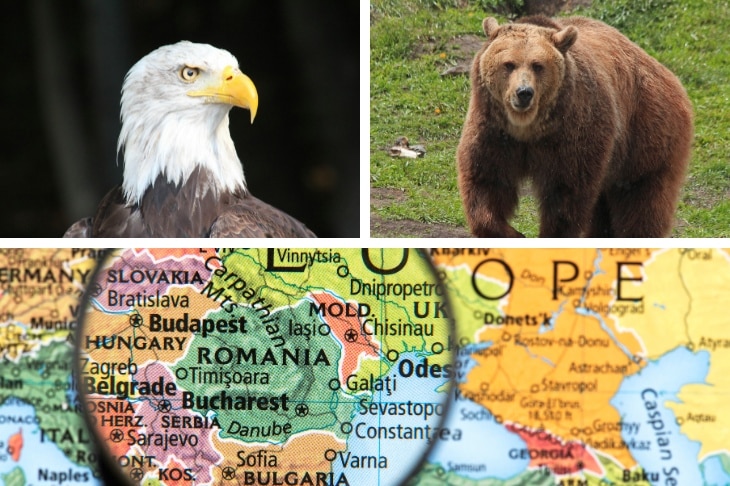
The eagle or the bear?
The question of Romania between West and East is not just about geography. It is about identity, values, and future direction.
Romania has already made its choice once, in 1989, and again through NATO and EU integration. But this choice must be renewed again and again, through actions, not just words.
The country is no longer the same as it was decades ago. It is stronger, more open, and more connected to the world. Still, the pressures from the East have not disappeared.
In the end, the question is not whether Romania can choose between the eagle or the bear. The real question is whether it will stay consistent with the path it has already chosen.
And that decision belongs not only to leaders, but to society as a whole.